Contact Us
E-mail:liuzhouboan@163.com
Phone/WeChat:13768899143
Address:Baian Transformer Co., Ltd., Liujiang District, Liuzhou City, Guangxi Zhuang Autonomous Region (209 National Highway)
Product Center
The main difference between oil-immersed transformers and dry-type transformers is whether there is "oil" or not. Since oil is a liquid and has fluidity, oil-immersed transformers must have a shell, with aviation hydraulic oil inside the casing, and the electromagnetic coils of the transformer are immersed in the oil, making the coils invisible from the outside. In contrast, dry-type transformers do not have oil and do not require a casing, allowing the electromagnetic coils of the transformer to be seen directly.
SBH15 fully sealed oil-immersed amorphous alloy transformer/oil-immersed transformer
The main difference between oil-immersed transformers and dry-type transformers is whether there is "oil" or not. Since oil is a liquid and has fluidity, oil-immersed transformers must have a shell, with hydraulic oil inside the casing. The electromagnetic coils of the transformer are immersed in the oil, making the coils invisible from the outside.
Oil-immersed transformer / Oil-immersed transformer manufacturer / Power transformer
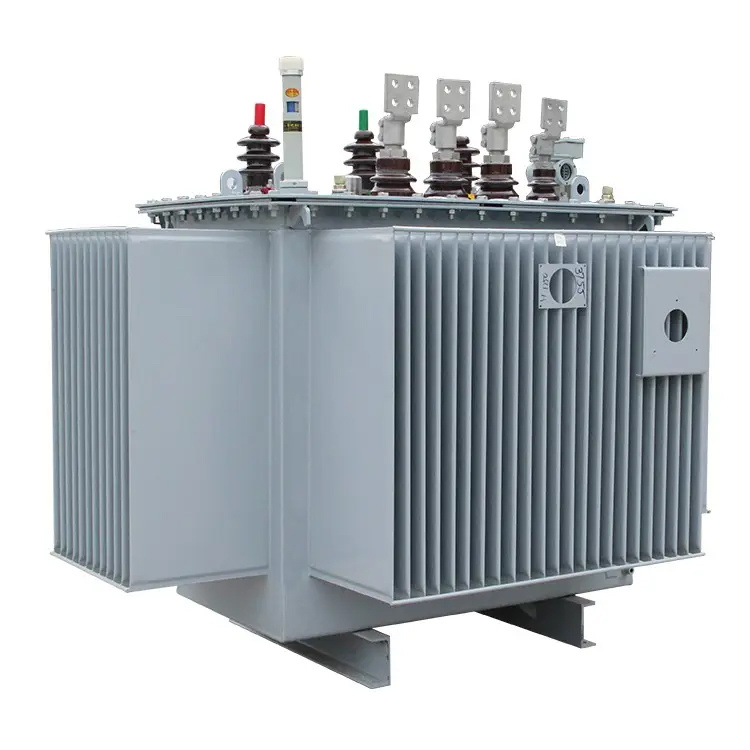
The main difference between oil-immersed transformers and dry-type transformers is whether there is "oil" or not. Since oil is a liquid and has fluidity, oil-immersed transformers must have a shell, with aviation hydraulic oil inside the casing, soaking the electromagnetic coils of the transformer, which are not visible from the outside. In contrast, dry-type transformers do not have oil and do not require a casing, allowing the electromagnetic coils of the transformer to be seen directly. One characteristic is that oil-immersed transformers have an oil cushion on top, which stores aviation hydraulic oil; however, modern three-phase oil-immersed transformers are also manufactured without an oil cushion.
20KV oil-immersed transformer/oil-immersed transformer/dry-type transformer
The main difference between oil-immersed transformers and dry-type transformers is whether there is "oil" or not. Since oil is a liquid and has fluidity, oil-immersed transformers must have a shell, with aviation hydraulic oil inside the casing, and the electromagnetic coils of the transformer are immersed in the oil, making the coils invisible from the outside. In contrast, dry-type transformers do not have oil and do not require a casing, allowing the electromagnetic coils of the transformer to be seen directly.
Oil-immersed transformer S11-M-1000/10

The main difference between oil-immersed transformers and dry-type transformers is whether there is "oil" or not. Since oil is a liquid and has fluidity, oil-immersed transformers must have a shell, with aviation hydraulic oil inside the casing, soaking the electromagnetic coils of the transformer, which are not visible from the outside. In contrast, dry-type transformers do not have oil and do not require a casing, allowing the electromagnetic coils of the transformer to be seen directly. One characteristic is that oil-immersed transformers have an oil cushion on top, which stores aviation hydraulic oil; however, modern three-phase oil-immersed transformers are also manufactured without an oil cushion.